Prof. Sabira Habeeb compering the programme
From left: Abid Sohail, Masroor Jahan, Prof. Sharib Rudaulvi, Prof. Roop Rekha Verma, Shailendra Sagar, Dr. Sabiha Anwar and Dr. Ayesha Siddiqui
 From left: Prof. Sharib Rudaulvi, Shailendra Sagar, Dr. Sabiha Anwar and Dr. Ayesha Siddiqui
 Prof. Sabira Habeeb compering the programme
 The audience, completely absorbed in the stories
 Muhammad Nasim, President of the Azad Memorial Academy, Lucknow, introducing the theme

 Masroor Jahan reading out her story "Sach ke Sivaa"
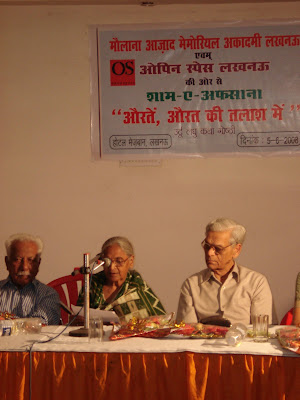 Masroor Jahan reading out her story "Sach ke Sivaa"
 Dr. Ayesha Siddiqui reading out her story "Unvaan ke Aari"
 Dr. Ayesha Siddiqui reading out her story "Unvaan ke Aari"
 The Audience
 Dr. Sabiha Anwar reading out her story Andhera Rasta
 Dr. Sabiha Anwar reads out her story Andhera Rasta while the chief guest Prof. Roop Rekha Verma listens attentively
 Dr. Sabiha Anwar reading out her story Andhera Rasta
 Dr. Sabiha Anwar reading out her story Andhera Rasta
 Short Story Writer Shailendra Sagar expressing his views
 Eminent Short-Story Writer Abid Sohail making his comments
 Dr. Nusrat Nahid, Librarian, Amiruddaula Public Library, and a known poet, reading out a poem of hers
 Dr. Nusrat Nahid, Librarian, Amiruddaula Public Library, and a known poet, reading out a poem of hers
 The Chief Guest, Prof. Roop Rekha Verma, Former Vice Chancellor, University of Lucknow and a known Social Activist addressing the gathering
 The Chief Guest, Prof. Roop Rekha Verma, Former Vice Chancellor, University of Lucknow and a known Social Activist addressing the gathering
 Prof. Sharib Rudaulvi, who presided over the story-reading session, commenting on the stories and taking part in the discussion
 Prof. Sharib Rudaulvi, who presided over the story-reading session, commenting on the stories and taking part in the discussion
The Centre for Communication and Development Studies, Pune
organised an
Urdu Short-Story Reading Session by Lucknow's three leading lady writers followed by a Discussion
under the auspices of its
civil society and youth outreach initiative
Open Space
in collaboration with
the Maulana Azad Memorial Academy, Lucknow
on
Thursday, 5th June 2008 at 5 p.m.
in
Lucknow. Stories on women's themes were read out by Lucknow's three foremost lady writers, viz., Masroor Jahan, Dr. Ayesha Siddiqui and Dr. Sabiha Anwar. Masroor Jahan's story
"Sach ke Sivaa" explored the problem of the sexual exploitation of woman by her husband for career benefits, while Dr. Ayesha Siddiqui's story
"Unvaan ke Aari" focussed on the victimisation of woman due to superstitions. Dr. Sabiha Anwar's story
"Andhera Rasta" depicted how after a dowry murder, the parents of the bride often try to cover up. The story tries to understand their psyche.
The session was presided over by noted critic Prof. Sharib Rudaulvi (Jawaharlal Nehru University). Former Vice Chancellor of the University of Lucknow and a prominent social activist, Prof. Roop Rekha Verma was the Chief Guest. Prof. Sabira Habeeb (Lucknow University) compered the session. The reading session was followed by a lively panel discussion. The panel consisted of prominent writers and critics, viz., Abid Sohail, Shailendra Sagar and
Anwar Nadeem.
Anwar Nadeem said:
There are many who made fun of the title of today's programme, but the fact remains that no one gives better expression to woman's problems than the woman herself. It is sad that although there is a strong presence of women in mushairas (Urdu poetry recitation sessions), yet there is no one like Parveen Shakir and Bano Daraab "Vafaa", who so successfully expressed women's sentiments and drew attention to their problems. Today's symposium should motivate and inspire the three great writers we have with us today to write the way Parveen Shakir and Bano Daraab "Vafaa" did.
The biggest flaw of Urdu fiction is that it is written in Urdu. The fact is that neither Urdu nor Hindi can be the language of any story. It has to be in colloquial "Hindustani", as Mahatmi Gandhi termed it. This is also sad that the Urdu writer while writing stories tries to keep himself or herself from writing dialogues, which only indicates his lack of proper knowledge of the variety of characters that exist in society.
Shailendra Sagar said:
Discussion about a story is extremely important, but it is possible only when it has been read and not heard.
Abid Sohail said:
All the three stories read out today had strong female characters. The stories revolved around these characters, but with the intention of opposing the established norms and conventions and to encourage the people to break the deafening silence. They were all rebellious in nature.
Prof. Sharib Rudaulvi greatly appreciated the three stories read out and stressed the need for more of such symposia at a greater frequency to motivate people to make positive changes in society.
Prof. Roop Rekha Verma said:
Woman needs to search her womanliness and at the same time attain her rightful place in the world as a citizen equal to man in every respect.
The biographies of the three great lady writers who read out their stories on women's themes are as follows:
Masroor JahanUrdu Novelist, Short-Story Writer and Broadcaster
 Title Cover of Masroor Jahan's collection of short stories Pul Sirat, 2006
Has published 65 novels and 500 short-stories, a number of which have been translated into Hindi, Tamil, Telugu, Kannad, Punjabi and English. Has received a number of prestigious awards like the Fankar Society Award, Buzm-e-Urdu Award and the Buzm-e-Khavaateen Award, Meer Academy Award, etc.
Dr. Ayesha SiddiquiShort-Story Writer, Essayist, Humourist, Translator, Broadcaster, Educationist and one of Asia-Pacific's Who's Who
Publications:Ghoomte Chauk ki keel, 1982
Poorvi Deson ki Kahaniyan, 1988 (Collection of Foreign Language Folk-Tales in Urdu)
Has published a number of short stories in the most prestigious literary journals like
Shama, Beesvi Sadi, Naya Daur, Aaj Kal, Dharm Yug, Sarika, Bano, Nakoosh, etc.
Dr. Sabiha AnwarPrincipal, Karamat Husain Muslim Girl's Post-Graduate College, University of Lucknow
 Publications:Warq Warq Zindagi
, Collection of Short-Stories (1975)
Urdu Mein Khudnavisht Savaane Hayat (1982)
Baqi Savalat, A Critical Study of Interviews (1990)
Chapters:"Asari Adab Mein Afsana",
Awaz Short-Story Number, June 1978
"Sir Raza Ali - Fikr-o-Nazar,
Karwane Aligarh Number, 1980
"Ruswa aur Unki Shahkaar Tahreer,
Qaumi Awaz, August 1981
"Chakbast aur Ihtiram-e-Insaaniyat,
Awaz, November 1981
"Talkhees Jahan Danish", Uttar Pradesh Urdu Academy Journal, April, 1982
"Josh Malihabadi aur Unki Fikr",
Moallim-e-Urdu, May 1982
Apart from the above publications, she has published more than a dozen articles and over fifty short-stories in prestigious journals like Aaj Kal, Naya Daur, Aiwan-e-Urdu, Alfaz Nigar, Shama, Roshan Adab and Bano.
Awards:1975 Uttar Pradesh Urdu Academy Award for her collection of short-stories Warq Warq Zindagi
1981 Urdu Adab Award from the Mahila Sewa Sansthan
1982 Uttar Pradesh Award for her book
Urdu Mein Khud Navisht Savaneh Hayat (An Analysis of Autobiographical Writing in Urdu)
1982 Meer Academy Award in recognition of her literary contributions
1988 Adeeb International Society Award for the promotion of Art, Culture and Literature
1992 Certificate of Appreciation from the Lions Club of Lucknow for her services to society as an